
As Europe accelerates its transition towards a sustainable, climate-neutral future, each region faces unique challenges, resources, and socioeconomic realities. Recognising this diversity, CIRCUIT places local communities at the heart of the transition, bringing together the people who live and work in these regions to co-create solutions that work in practice, not just in theory.
What co-creation means for CIRCUIT?
For CIRCUIT, co-creation is an ongoing, iterative process in which diverse stakeholders actively contribute to shaping ideas, identifying local needs, and developing tangible solutions that respond to the realities of their regions. This approach is a cornerstone of our project, ensuring that the tools, solutions and models we develop are socially accepted, practically viable, and rooted in real community needs.
Our co-creation framework is built around three main steps (inventory, transition bridges and feedback cycle) and four anchor points: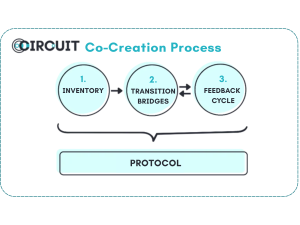
- Raising awareness: Building a shared understanding of circularity and its local benefits.
- Co-Planning & Design: Working hand-in-hand with communities to design tailored interventions.
- Governance: Establishing inclusive frameworks for decision-making and continuous feedback loops.
- Capacity building: Empowering local actors with the skills needed to sustain these initiatives.
Together, these steps shape an enabling environment, setting the stage for participatory research, collaborative innovation and the continuous improvement of our solutions.
The co-creation journey: from Pop-Up Hubs to the Impact Cafés
To bring this co-creation approach to life, CIRCUIT has established a network of local Pop-up Hubs across its participating regions. These Hubs serve as dynamic physical, virtual, or hybrid spaces, designed to connect stakeholders, resources, and knowledge, enabling industrial symbiosis, circular innovation, community engagement, and sustainable territorial development. Through co-creation, experimentation and testing, our ambition is to accelerate the transition towards regenerative, inclusive and circular regional economies while strengthening societal readiness and local resilience.
A crucial first step in establishing the Hubs was a comprehensive ecosystem mapping exercise that enabled project partners to identify and engage a diverse range of key actors, including industry representatives, local and regional authorities, research institutions, local community organisations, and potential end-users of the CIRCUIT solutions. By bringing these varied perspectives to the table, the Hubs transform individual insights into collective, targeted action.
The activation of the local Hubs is achieved via a series of kick-off events, the CIRCUIT Impact Cafés, hosted by our clusters in Spain, Italy, Finland, Sweden, Portugal, Greece, Ireland and Slovenia.
The preparation for these events was itself a critical learning process, with CIRCUIT partners engaging in internal workshops and scoping sessions to define user and system requirements, map existing initiatives, understand local challenges, and align expectations across demonstrator and replication sites. A critical milestone achieved was the Stakeholder Integrated Co-Design Framework, providing a common approach for partners to organise the co-creation process while allowing each Hub to adapt its activities to the local context.
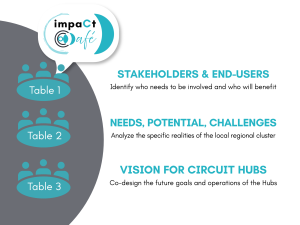
To foster genuine dialogue, the Impact Cafés utilise the World Café methodology, a highly interactive approach designed to encourage open conversation and knowledge exchange among individuals with diverse backgrounds. During these events, participants rotate through three distinct discussion tables, each focusing on a different topic, spanning from target audiences to needs, potential and challenges of each cluster and closing with the vision for the CIRCUIT hubs.
What comes next? The rich insights, ideas, and feedback collected during the Impact Cafés will directly feed into our upcoming activities. Each demonstrator and replication case will develop a concise, localised protocol, outlining specific missions, scenarios, milestones, roles, and KPIs that integrate critical social dimensions and innovation. This collaborative conceptual work will be presented to the Regions and Cities Advisory Panel (RCAP). Acting as our strategic advisory board, the RCAP will evaluate the feasibility, scalability, and strategic alignment of the proposed local actions. Through their guidance and the establishment of a robust Knowledge Alliance between demonstrator and replicator regions, we will continuously refine our understanding of regional challenges and ensure our local actions align with broader European objectives.
The team behind CIRCUIT’s co-creation activities
Delivering meaningful co-creation requires close collaboration across the entire consortium. The successful preparation and implementation of the Pop-up Hubs and Impact Cafés are the result of a joint effort involving multiple project partners:
- ZSI & University of Thessaly lead the development of the co-creation methodology, deliver training activities, and provide the practical guidance and resources required to build the Pop-up Hubs and organise the Impact Cafés successfully.
- Cluster partners play a pivotal role at regional level by conducting the stakeholder mapping, engaging local actors, organising events, and facilitating the discussions on their region’s specific needs, priorities, and ambitions.
- AUSTRALO, as the Communication and Dissemination lead, supports the entire process by developing the necessary promotional materials and guidelines while running dedicated campaigns to maximise reach and visibility.
Ultimately, this effort goes far beyond benefiting the CIRCUIT project alone. Through the Pop-up Hubs and Impact Cafés, participants gain a deeper understanding of the circularity challenges and opportunities within their regions while becoming active contributors to the development of practical solutions. More importantly, they become part of a broader movement that places communities at the centre of decision-making and innovation. CIRCUIT envisions a future where action is community-driven, and these initiatives actively provide a vital platform for community inclusion, ensuring local voices are heard, and action strategies are built on real, localised needs.
After all, meaningful change starts with the people and communities who will make it happen!